
HELPING AN ADULT CHILD FINANCIALLY
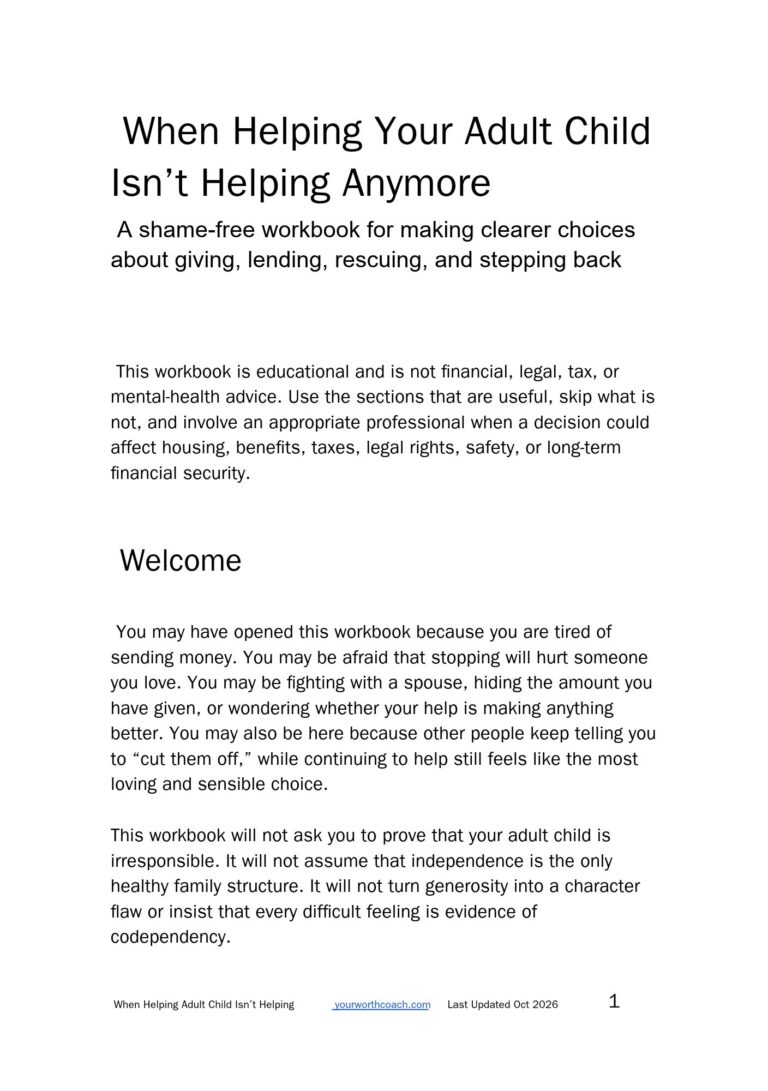
When Helping Your Adult Child Isn’t Helping Anymore
A shame-free workbook for making clearer choices about giving, lending, rescuing, continuing support, and stepping back.
Maybe you are tired of sending money.
Maybe you are afraid that stopping will hurt someone you love.
Maybe you and your spouse keep having the same argument.
Maybe the support is completely affordable, but the unpredictability, guilt, or resentment is not.
Or maybe everyone keeps telling you to “cut them off,” and continuing to help still feels like the most loving and sensible choice.
This workbook does not start by deciding that you are helping too much.
It helps you understand the arrangement well enough to choose what happens next.
128-page digital PDF • 8-part guided workbook • 12 reusable quick-use tools • Use at your own pace
The goal is not to finally say no.
The goal is to make yes, no, not now, and “let’s look at this together” all genuinely available choices.
You do not have to want to stop helping.
A lot of advice about financially supporting adult children starts with a conclusion:
They need to become independent.
You need better boundaries.
You are rescuing them.
You need to stop.
Sometimes one of those things may be true.
Sometimes it is not.
Financial support between generations can provide housing, stability, disability support, childcare, education, recovery time, opportunity, shared family wealth, or simple generosity.
The useful question is not automatically:
“How do I make this stop?”
It may be:
“What is this support doing?”
“Is it sustainable?”
“Is it still accomplishing what we think it is accomplishing?”
“Can we talk about it honestly?”
“Do I still have meaningful choices?”
You are allowed to keep helping. You are also allowed to change how you help.
Start with the arrangement in front of you.
Financial support rarely arrives as one grand family decision.
It grows one phone bill, emergency transfer, grocery run, rent payment, co-signed loan, subscription, childcare arrangement, or “just this once” at a time.
Eventually, no one may have a complete picture.
Before deciding whether anyone is helping too much, the workbook helps you look at:
WHAT IS HAPPENING
What support is actually being provided?
WHAT JOB IT IS DOING
What does the money make possible , for your adult child, for you, and for the relationship?
WHAT IT COSTS
Financially, emotionally, relationally, and practically.
WHAT VALUE IT CREATES
What would genuinely be lost if the support changed?
WHAT CHOICES ARE AVAILABLE
Continue, restructure, reduce, pause, clarify, transition, decline, or do something you have not considered yet.
An inventory is not an indictment.
You can name a pattern without diagnosing a person.
Words like enabling, rescuing, dependent, codependent, spoiled, and irresponsible can sound explanatory while making it harder to see what is actually happening.
This workbook treats these as descriptions of patterns , not identities.
SUPPORT
May meet a need, expand options, create safety, or reflect chosen interdependence.
RESCUE
May happen when someone moves quickly to remove distress or consequences, often before the other person has asked or participated.
ENABLING
May describe support that repeatedly preserves a problem one or both people want to change.
FINANCIAL ENMESHMENT
May happen when money and emotional boundaries become so intertwined that support, loyalty, access, approval, or autonomy are difficult to separate.
The point is not to choose the harshest label.
The point is to ask:
What is this pattern doing?
Can it be discussed?
Can it be changed?
Does either person want something to be different?
Evaluate the system. Do not assign a villain.
A choice can cost you something and still be worth choosing.
One of the fastest ways to make this decision impossible is to look at only half of it.
If you only look at the cost, generosity can begin to look foolish.
If you only look at the value, you may ignore a financial or emotional burden that is no longer sustainable.
The workbook asks you to hold both.
COST MAY INCLUDE:
Current cash flow
Debt
Emergency savings
Retirement
Healthcare
Housing
Time and administrative labor
Conflict with a spouse or partner
Secrecy
Sleep
Attention
Reduced freedom
Fear of the next request
Monitoring or policing
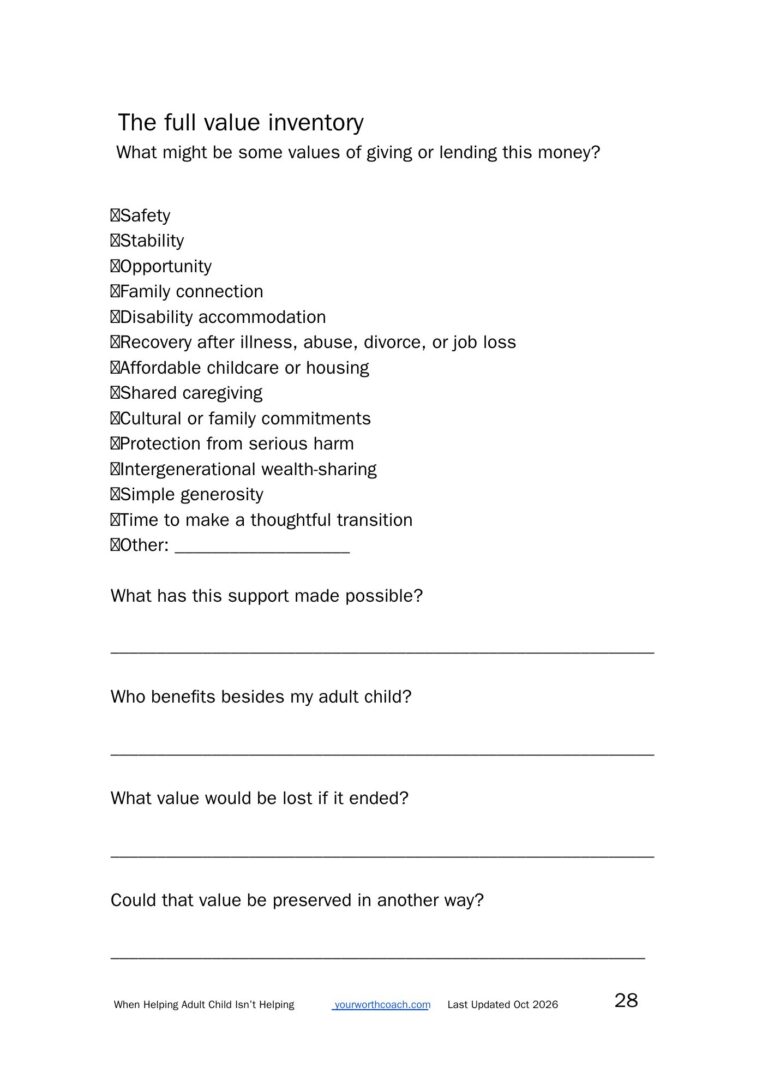
VALUE MAY INCLUDE:
Safety
Stability
Opportunity
Family connection
Disability accommodation
Recovery after illness, abuse, divorce, or job loss
Affordable childcare or housing
Shared caregiving
Cultural or family commitments
Protection from serious harm
Intergenerational wealth-sharing
Simple generosity
Time to make a thoughtful transition
PROMPT:
What has this support made possible?
What has it cost?
Which costs do I willingly choose?
Which costs have become unsustainable?
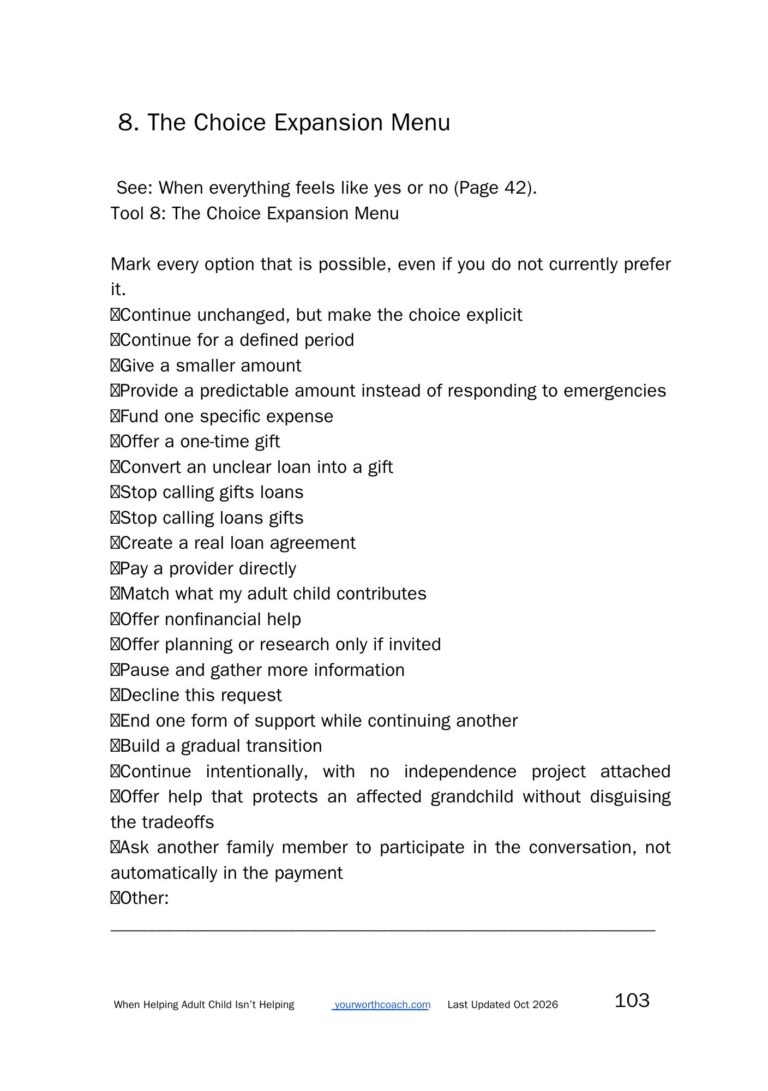
The choice is rarely “keep paying for everything” or “cut them off.”
Once you can see what the support is actually doing, you can widen the option set.
You might:
- Continue exactly as you are , but make the choice explicit.
- Continue for a defined period.
- Give a smaller or more predictable amount.
- Fund one specific expense.
- Offer a one-time gift.
- Convert an unclear loan into a gift.
- Create a real loan agreement.
- Pay a provider directly.
- Match what your adult child contributes.
- Offer nonfinancial help.
- Pause while you gather information.
- End one form of support while continuing another.
- Build a gradual transition.
- Continue intentionally, with no “independence project” attached.
- Decline this request.
- Choose something else entirely.
The goal is not to find the toughest option.
The goal is to find an option you can actually stand behind.
More choices create better decisions.
Not every kind of help carries the same risk.
A $300 gift, a monthly phone bill, co-signing a mortgage, allowing someone to move into your home, and promising indefinite financial support are not versions of the same decision.
The workbook gives you a simple way to examine each option through three lenses:
RISK
What could go wrong, for whom, and how serious would it be?
CAPACITY
Can I afford this financially, emotionally, relationally, and administratively?
REVERSIBILITY
If we try this, how difficult would it be to change later?
You will also identify what information is missing and when another professional may need to be involved.
Because protecting your own retirement, housing, health, partnership, or emergency capacity is not the opposite of caring about your adult child.
Those resources are part of the family system too.
High-stakes decisions involving taxes, benefits, property, debt, legal rights, or safety may require specialized guidance.
Changing the arrangement may feel worse before it feels clearer.
Sometimes the hardest part is not deciding what you want to do.
It is saying it without overexplaining, prosecuting, monitoring, apologizing for existing, or getting pulled into an argument about whether you are allowed to make the choice.
The workbook includes a Conversation Planner and language you can adapt.
FOR CONTINUING SUPPORT:
“I’ve looked carefully at this, and I want to keep providing ______. I can afford it, and I want to be clear that it is a gift, not a vote on how you live.”
FOR ADDING STRUCTURE:
“I can contribute ______ through ______. Let’s plan to revisit it on ______ rather than waiting for another crisis.”
FOR DECLINING:
“I’m not able to provide the money for this. I care about what happens next, and my answer is still no.”
FOR NEEDING TIME:
“I am not deciding this while either of us is panicked. I will get back to you by ______.”
FOR REMAINING CONNECTED:
“My answer about the money is no. I still care about what you are facing.”
The goal is not magic wording that prevents anyone from having feelings.
The goal is language clear enough that the arrangement does not depend on guessing.
A boundary is not a test. A decision does not “work” only if the other person responds the way you hoped.
A clear decision still has to survive a real conversation.
The hours and days after a money decision can be surprisingly difficult.
Someone may be angry.
You may feel guilty.
A spouse may second-guess the plan.
You may have a strong urge to reverse the decision just to make the tension disappear.
That does not automatically mean the decision was wrong.
The workbook helps you distinguish:
DISCOMFORT
Guilt, disappointment, anger, grief, unfamiliarity, or the urge to make tension disappear.
DANGER
Concrete risks involving housing, food, healthcare, safety, necessary transportation, or a dependent person.
NEW INFORMATION
A fact you genuinely did not have when you made the decision.
You’ll create an After-the-Conversation Stabilization Plan so you can respond to new information without treating every difficult feeling as an emergency.
A boundary is not a test. A decision does not “work” only if the other person responds the way you hoped.
Inside the workbook
This is a 128-page digital workbook designed to be useful from beginning to end , or entered through the section that matches the decision in front of you.
THE 8-PART GUIDED WORKBOOK INCLUDES:
Part 1: What Is Actually Happening?
See the full support picture, including arrangements that have become invisible or automatic.
Part 2: What Jobs Is the Money Doing?
Understand what the support accomplishes for your adult child, for you, and for the relationship.
Part 3: What Does This Support Cost, and What Does It Make Possible?
Look at cost and value together, then assess risk, capacity, and reversibility.
Part 4: Identify the Pattern Without Diagnosing the People
Explore support, rescue, enabling, enmeshment, repeating cycles, and family roles.
Part 5: What Choices Are Actually Available?
Get out of the yes/no trap and compare a wider range of possible arrangements.
Part 6: Make the Choice Clear Enough to Live With
Clarify gifts, loans, shared expenses, expectations, privacy, review dates, and conversation language.
Part 7: What Happens After the Decision?
Prepare for guilt, anger, uncertainty, new information, and the temptation to reverse a choice in panic.
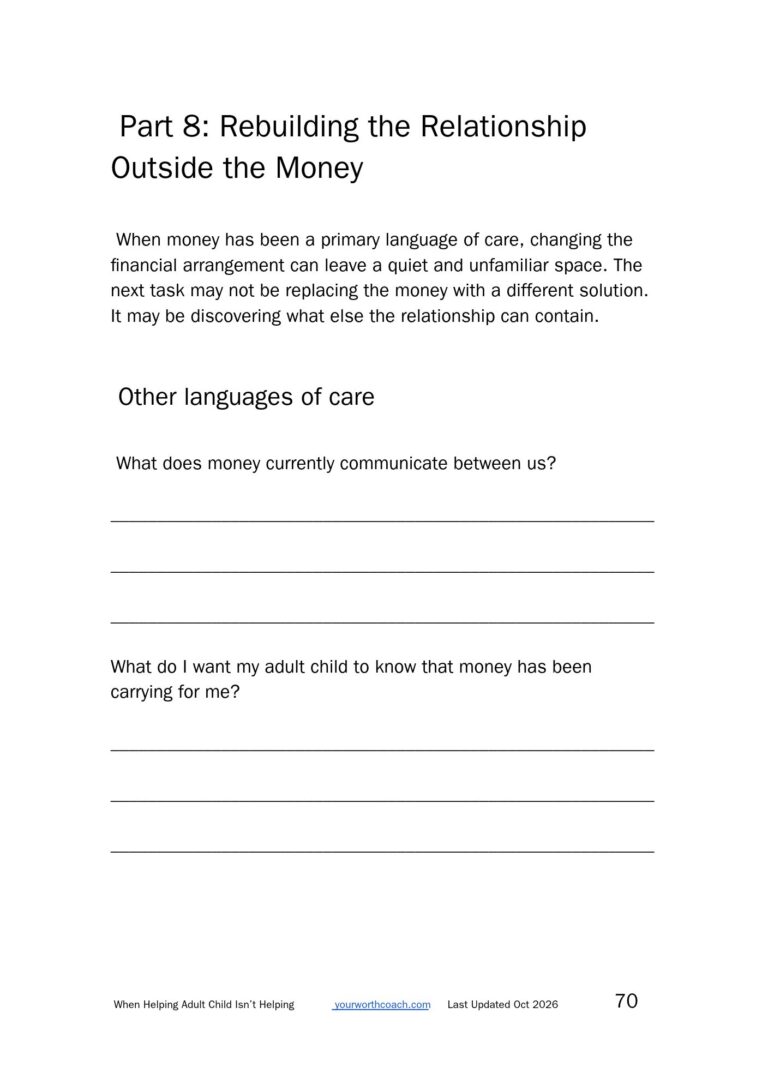
Part 8: Rebuilding the Relationship Outside the Money
Explore other languages of care, grief, chosen interdependence, and the kind of financial relationship you want going forward.
Peek inside the workbook.
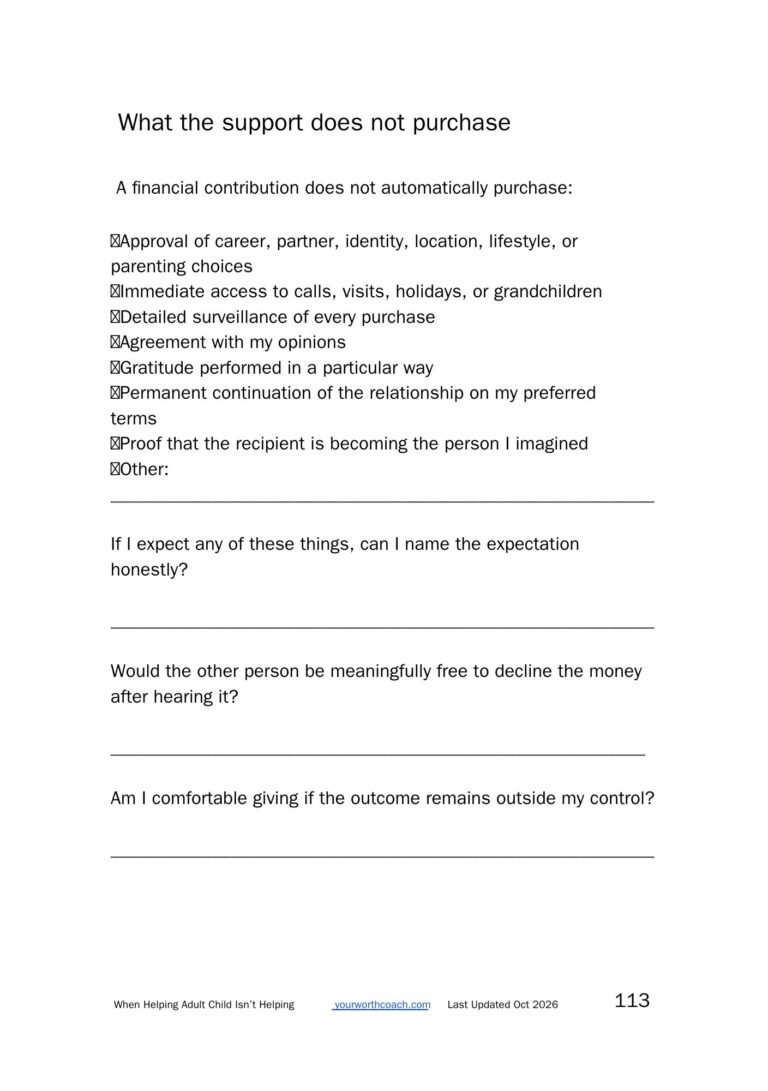
This is a 128-page digital workbook designed to be useful from beginning to end , or entered through the section that matches the decision in front of you.
THE 8-PART GUIDED WORKBOOK INCLUDES:
Part 1: What Is Actually Happening?
See the full support picture, including arrangements that have become invisible or automatic.
Part 2: What Jobs Is the Money Doing?
Understand what the support accomplishes for your adult child, for you, and for the relationship.
Part 3: What Does This Support Cost, and What Does It Make Possible?
Look at cost and value together, then assess risk, capacity, and reversibility.
Part 4: Identify the Pattern Without Diagnosing the People
Explore support, rescue, enabling, enmeshment, repeating cycles, and family roles.
Part 5: What Choices Are Actually Available?
Get out of the yes/no trap and compare a wider range of possible arrangements.
Part 6: Make the Choice Clear Enough to Live With
Clarify gifts, loans, shared expenses, expectations, privacy, review dates, and conversation language.
Part 7: What Happens After the Decision?
Prepare for guilt, anger, uncertainty, new information, and the temptation to reverse a choice in panic.
Part 8: Rebuilding the Relationship Outside the Money
Explore other languages of care, grief, chosen interdependence, and the kind of financial relationship you want going forward.
And then there is the part you can keep using.
Appendix A turns the workbook into a reusable decision kit.
Once you understand a tool, you do not have to hunt through the teaching sections every time a new request, decision, or family conversation appears.
You get clean quick-use copies of all 12 signature tools:
- The Decision Pause
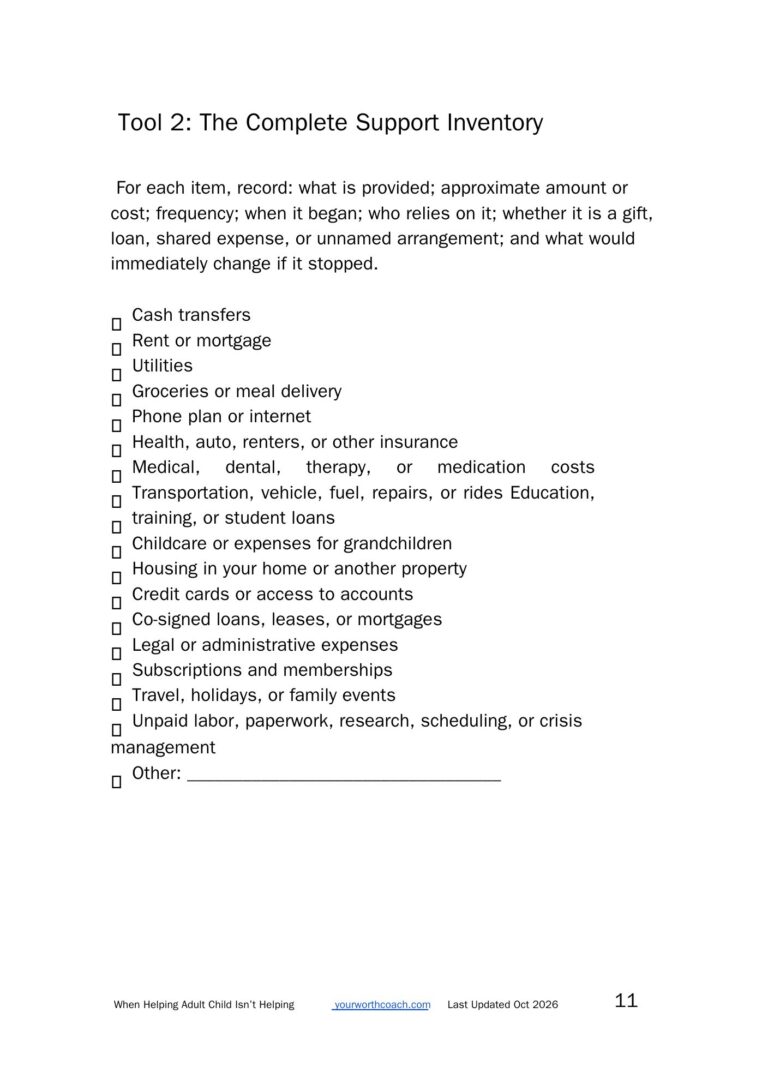
- The Complete Support Inventory
- The Jobs the Money Is Doing Map
- Immediate Relief / Later Effects
- Full Cost and Full Value Inventory
- Risk–Capacity–Reversibility Matrix
- The Repeating-Cycle Map
- The Choice Expansion Menu
- Purpose of Each Option Comparison
- Gift, Loan, or Unnamed Arrangement?
- The Conversation Planner
- After-the-Conversation Stabilization Plan
Use the full workbook to understand the framework.
Then come back to the tool you need when the situation changes.
SHARING NOTE:
The full workbook is for the purchaser’s personal use. You may print or share individual blank quick-use tool pages with family members directly involved in the same decision or conversation.
Learn it once.
Reuse the tool when you need it.
This workbook may be useful if…
- You regularly give or lend money to an adult child and are not sure whether the arrangement still fits.
- You keep responding to emergencies and want to understand the larger pattern.
- You and a spouse or co-parent disagree about financial support.
- You feel guilty saying no , or resentful saying yes.
- You are afraid that changing the money will damage the relationship.
- You want to continue helping, but want the arrangement to be clearer and more sustainable.
- You are trying to distinguish generosity from rescue, enabling, control, or obligation.
- The money has become tied to access, loyalty, approval, guilt, or family roles.
- You need to think through a gift, loan, co-signing decision, housing arrangement, or transition.
- You want practical tools instead of another lecture about what a “good parent” should do.
A clearer way to make the next decision.
YOU GET:
- The complete 128-page When Helping Your Adult Child Isn’t Helping Anymore workbook
- 8 guided sections for understanding and redesigning the financial arrangement
- 12 signature decision tools
- A separate quick-use appendix with clean copies of all 12 tools
- Conversation language you can borrow and adapt
- Guidance for recognizing when legal, tax, financial, benefits, therapeutic, advocacy, or safety support may be useful
- A digital PDF you can print or use on your own device
- Permission to print/share individual blank quick-use tool pages with family members directly involved in the same decision or conversation
PRICE:
$39
Questions you might have
Q: Does this workbook tell me whether I should stop helping my adult child?
No. That is the decision the workbook is designed to help you make more clearly.
It does not assume that financial independence is the only healthy family structure, and it does not assume that continued support is automatically enabling.
You may finish the workbook and decide to keep helping exactly as you are. You may decide to restructure the support, reduce it, clarify it, transition it, or stop one part of it.
The goal is more choice and better information… not a predetermined answer.
Q: Is this only for parents with an “irresponsible” adult child?
No.
The workbook is about financial arrangements, not character judgments.
It can be useful in situations involving disability, job loss, housing costs, divorce, caregiving, grandchildren, education, health concerns, cultural expectations, shared family wealth, repeated emergencies, unclear loans, ongoing support, or simply a financial arrangement that has become hard to understand or discuss.
Q:What if I can afford to keep helping?
Then affordability may not be the problem.
You may still want to look at predictability, resentment, family conflict, expectations, privacy, control, risk, administrative labor, or whether the arrangement is still doing the job everyone thinks it is doing.
You may also discover that the arrangement is affordable, valuable, and something you genuinely want to continue.
That is useful information too.
Q: What if my spouse or co-parent disagrees with me?
The workbook includes prompts for identifying who else is financially or relationally affected, what agreements already exist, which decisions require joint consent, and where secrecy or assumptions may be adding strain.
It does not assume that one partner is automatically right.
Q: Can I use this with my adult child?
The workbook is written primarily for the person making decisions about the support.
You may choose to share individual blank quick-use tool pages with family members directly involved in the same decision or conversation.
Completed workbook pages should not be used as evidence in a prosecution of your adult child.
Q: Is this therapy or financial advice?
No.
This is an educational decision-making workbook. It is not financial, legal, tax, medical, or mental-health advice.
Some decisions deserve specialized support, particularly when housing, public benefits, taxes, property, debt, legal rights, safety, coercion, violence, substance use, gambling, cognitive decline, or long-term financial security are involved.
Q: Do I have to complete all 128 pages?
Absolutely not.
You can work from beginning to end, but you can also enter through the decision in front of you.
The workbook includes “Follow the Thread” guidance throughout, and Appendix A gives you clean copies of the 12 signature tools for repeat use.
Q: Can I print it?
Yes. It is delivered as a digital PDF that you can use digitally or print for your own use.
You may also print or share individual blank quick-use tool pages with family members directly involved in the same decision or conversation.
Some decisions need more than a workbook.
This resource is designed to help you understand and make decisions about a financial arrangement.
It is not a substitute for financial, legal, tax, benefits, medical, mental-health, advocacy, or safety support.
Consider bringing in an appropriate professional when a decision involves:
- Co-signing or joint debt
- Property, housing, estate planning, inheritance, or trusts
- Gift or loan tax consequences
- Public benefits, disability benefits, Medicaid, or other eligibility
- Retirement, long-term care, or your ability to meet your own needs
- Formal loan, lease, caregiving, or shared-expense agreements
- Threats, coercion, stalking, violence, or retaliation
- Essential support being used as leverage
- Substance use, gambling, severe mental-health symptoms, or cognitive decline affecting safety or consent
- A conversation that may put someone in danger
You do not have to solve every part of the arrangement yourself.
Sometimes the next useful choice is bringing in someone whose job is to know the system.
You do not have to decide who the problem is.
You can begin with the arrangement in front of you.
You can keep what is working.
Change what is not.
Ask for more information.
Build a transition.
Keep helping.
Stop helping.
Offer something different.
Learn from what happens next.
Your adult child is allowed to have feelings about your choice.
You are allowed to have feelings about theirs.
Neither person’s distress automatically determines what the other must do.
Love does not require the absence of limits. Limits do not require the absence of love.
Get When Helping Your Adult Child Isn’t Helping Anymore
128-page digital PDF • 12 reusable decision tools • Immediate access