

Financial Communication for Couples
You’re great at communicating in your relationship…
Until it comes to money.
Then, it’s silence. Or stress. Or that same exhausting fight that never gets resolved.
This isn’t because you’re bad with money. It’s not because you’re emotionally immature.
It’s because most of us try to solve relational problems with system tools like budgets, spreadsheets, or “just get on the same page” advice. That’s like using a hammer to fix a WiFi signal.
This article introduces 10 relationship-first skills that will help you talk about money without blowing up, shutting down, or checking out. These skills come straight from trauma-informed financial coaching work with high-functioning couples who hit a money wall.
You can download the full guide here:
1. Give Yourselves Time
Money conversations are emotionally layered. Expecting yourselves to make overnight changes may be a set up for failure considering how long you’ve had not-so-great communication tools modeled for you PLUS the number of years you’ve personally experieced stressfull communication around money. Outside of coaching, expect this to take months, maybe years. That doesn’t mean you’re doing it wrong, it means you’re doing it with depth. And it means you are doing it right!
Progress is cumulative, and may not be immediately obvious. If you want to move through this quickly, see #2 coming up in a moment.
2. Practice patience and grace
This isn’t about lowering the bar. It’s about reducing urgency and judgment so you can actually change. Grace means making room for mistakes and misunderstandings without spiraling. Patience lets you pause instead of panic.
3. Be seen
Being seen isn’t about demanding that your partner understand you. It’s about transparent, direct, regulated communication: “I’m feeling uncertain about our savings” vs. “You don’t take this seriously.”
4. Control what you can control
You can’t change your partner’s reactions. But you can change how you show up. Instead of fixating on the budget or their tone, bring your focus back to your own behaviors and responses. That’s where real leverage is. And this isn’t about finding blame (in them OR you), it’s about controlling what you can.
5. Undermine perfectionism
Perfectionism tells us there is one “right way” to handle money. That lie leads to isolation, shame, and power struggles. Letting perfectionism go, however, may feel profoundly unsafe, so be gentle with yourself if you can’t immediately and magically just undo perfectionism. Your way and your partner’s way can coexist. In fact, your partner’s differing opinion/perspective might be exactly what is needed. Yours certainly is, right?
6. Be wrong
The more willing you are to be wrong, the safer your partner feels to experiment and try new things. It shifts the conversation from compliance to connection. Being wrong isn’t about failure, it’s
a muscle you build and it’s a gift to your relationship.
7. Practice curiosity
Not “What went wrong!?” but “Tell me more about that.” Not “How can we fix this?” but “What are you hoping for?” Curiosity without an agenda builds trust. It’s one of the most underrated intimacy skills in money conversations.
8. Undermine assumptions
Your brain will try to guess what your partner means. That guess is often wrong. Notice when we’re assuming is NOT easy, but it is do-able. The best way to do this is to practice curiosity with the “tell me more about that” prompt from #7!
You can only do this for yourself, not for your partner. That’s the work.
9. Leave the past in the past
Yes, the past matters. But if every financial conversation is a rerun of every past mistake, you’ll never move forward. Try having a 15-minute conversation together without bringing up the past. Even alone, that shift will change your dynamic.
10. Choose the right tool for the job
Relationship problems require relationship tools. System tools like budgets and debt payoff strategies have their place. But if what you’re facing is emotional disconnection or trust rupture? Spreadsheets will not help. Start with relationship tools first!
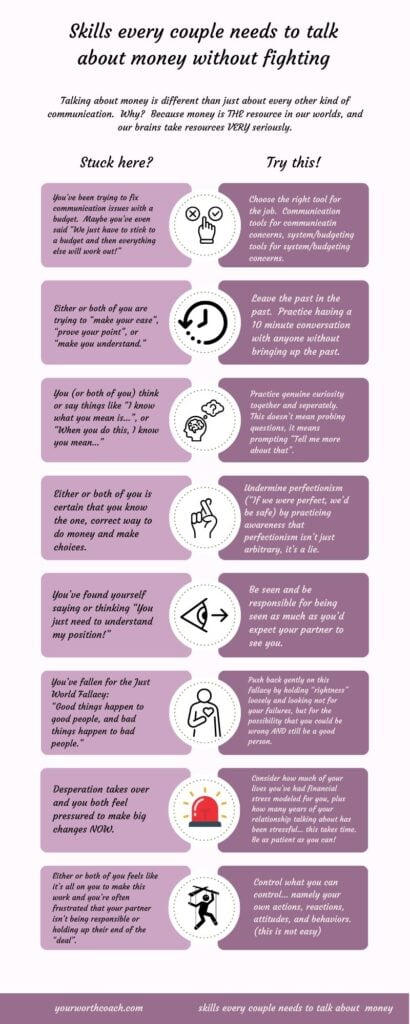
10 Common Stuck Points in Money Conversations (and What to Try Instead)
If talking about money with your partner feels harder than it should be… you’re not alone.
This visual guide breaks down 10 common stuck points couples face in financial conversations and offers gentle, practical ways to shift the dynamic without starting a fight.
These aren’t magic phrases. They’re communication habits that build trust over time.
(Save this. You’ll come back to it.)
Want to Put These Skills Into Practice?
Download the guide. Try one skill in your next conversation. Share it with your partner.
And if you want help applying these to your real, messy, beautiful, specific life
Let’s find some time next week for an info session!